Observability
Every command, console payload, and git mutation the agent performs is emitted as an OTLP event through the OTel Collector sidecar— secret-scrubbed— and stored in Elastic. From there it can be explored in a Kibana dashboard.
Send each team's telemetry to its own index
The dashboard and the OTLP receiver don't choose where data lands— the
exporter does, from a team.name routing key the run carries. Give each
DevOps/SRE team its own claude-agent-<team>-* indices (and RBAC) by deploying
a collector per team, or by routing on the attribute in one
shared collector. Set OTEL_TEAM on the pipeline to tag the run.
Dashboard sketch
This is a mockup, not a real dashboard
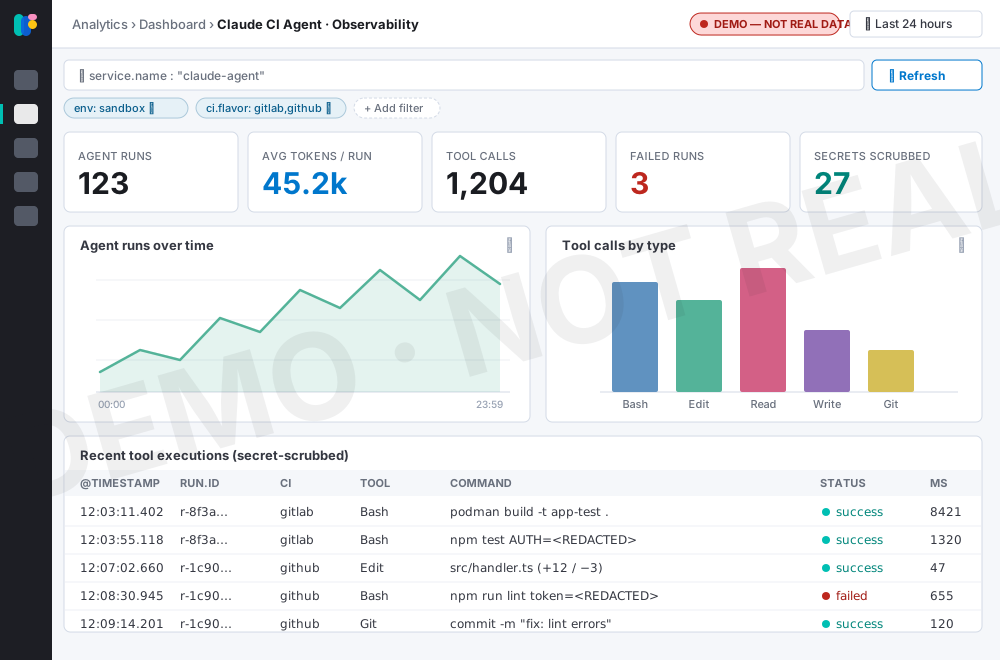
The image below is a styled mockup in the Kibana look-and-feel, to show what kind of panels a Claude CI Agent dashboard could surface. Every number, chart, and table row is fabricated— it is not a screenshot of a live Kibana view and contains no real data (hence the "DEMO— NOT REAL DATA" badge).
Panels we'd expect
- KPI tiles— agent runs, average tokens per run, total tool calls, failed runs, and secrets scrubbed.
- Agent runs over time— run volume across the selected time range.
- Tool calls by type— distribution across
Bash,Edit,Read,Write,Git. - Recent tool executions— a secret-scrubbed audit table (time, run id, CI flavor, tool, command, status, duration).
Filters across the top (time range, environment, CI flavor, service) scope every panel— the same OTLP attributes the collector already attaches to each event.
Per-run cost
Each run reports how much it cost in Anthropic API usage, taken from the
authoritative total_cost_usd in Claude's JSON result by
otel/emit_cost.py.
The cost is surfaced three ways:
- In the job log— a line like
💰 this run cost $0.4231 in Anthropic API usage · claude-sonnet-4-6 · 2 turns · 45,200 tokens · 1.5s(shown even when the collector is unreachable). - In the GitHub Actions run summary— a "Claude run cost" table on the job page.
- As an OTel metric—
cicd.claude.run.cost_usd(plus…run.duration_msand…run.tokensby type), tagged with CI/VCS attributes so cost is attributable per pipeline, branch, and personality in Elastic. Every datapoint also carriesclaude.model(the model that actually served the run) andgit.commit.sha/git.commit.short(the commit the run produced)— so you can answer "which model and which commit" for any run.
Client-side estimate
total_cost_usd is Claude Code's own estimate of the run's cost. It is ideal
for trend/attribution dashboards; reconcile against your Anthropic billing for
authoritative figures.